

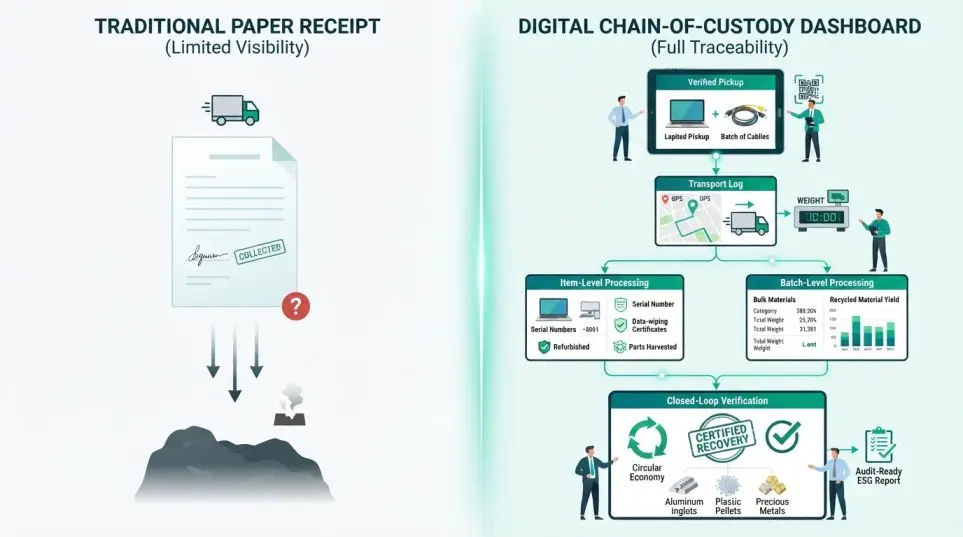
Corporate sustainability commitments are under closer scrutiny from investors, regulators, and customers than ever before. Yet a wide gap often separates what organizations promise from what actually happens to their retired equipment. Companies frequently hand over obsolete electronics and commercial waste to collection vendors and receive little more than a basic pickup receipt, confirming that materials left the building, but proving nothing about how they were processed.
That visibility gap can expose organizations to corporate greenwashing, even when their intentions are genuine. According to The Global E-waste Monitor 2024, the world generated 62 million tonnes of electronic waste in 2022, yet only 22.3% was documented as formally collected and recycled. For corporate sustainability teams including enterprises operating in island economies like Mauritius where export logistics, landfill limits, and ESG reporting standards converge unverified disposal creates growing reputational and compliance risks.
Digital traceability in waste management and ESG closes that gap. By combining item- and batch-level tracking from initial pickup to final material recovery, businesses can back their environmental claims with defensible, time-stamped evidence.
How Greenwashing Happens in Corporate Recycling
Greenwashing occurs when an organization presents its products, operations, or environmental impact as greener than the evidence supports. In corporate recycling, this rarely stems from deliberate deception alone; more often, it happens when companies report headline diversion or recycling numbers without proof of downstream outcomes.
A major driver is fragmented supply-chain visibility. Retired electronics and commercial waste typically move across multiple handlers—collectors, transport operators, refurbishment hubs, and downstream smelters or recyclers. When handoffs rely on disconnected spreadsheets or manual dockets, tracing the origin and final fate of materials becomes nearly impossible. As the Australian Government (2025) notes, structured chain-of-custody systems are essential for maintaining accurate records of recovered materials and substantiating recycled-content claims.
Without end-to-end documentation, organizations face three core risks:
-
Environmental leakage: Hazardous components—such as lead, mercury, and lithium-ion batteries—can be diverted into informal or unauthorized dumpsites.
-
Data-security breaches: Retired laptops, smartphones, and servers may enter secondary markets without certified data sanitization, creating regulatory and confidentiality exposure.
-
Unverified ESG disclosures: Sustainability reports that claim 100% responsible recycling without downstream processor proof can unravel during third-party assurance or stakeholder reviews.
Digital chain-of-custody tracking addresses all three by logging every custody transfer and linking collection data directly to verified processing outcomes. Learn more about digital chain-of-custody tracking.
How Digital Traceability Works: From Pickup to Final Recovery
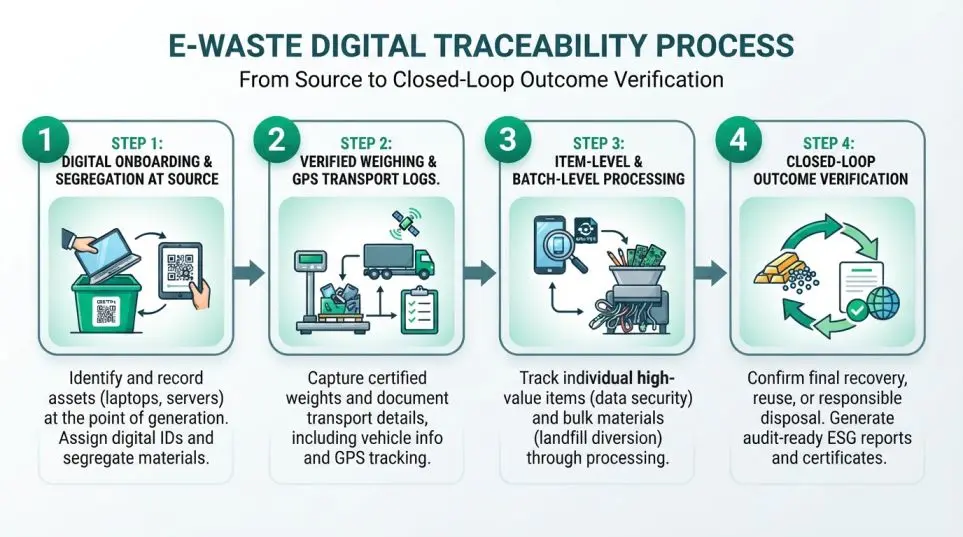
Digital traceability creates an unbroken, timestamped ledger as electronic waste moves from an organization’s premises through sorting, refurbishment, and final material recovery. Rather than relying on static paper receipts, operations follow four connected stages:
1. Digital Onboarding and Segregation at Source
Tracking begins before equipment leaves the client site. Retired devices—such as laptops, smartphones, servers, and networking hardware—are cataloged and sorted at pickup. High-value serialized assets are assigned unique digital IDs, while homogeneous low-value items are grouped into labeled lots so every stream is accounted for from the outset.
2. Verified Weighing and GPS Transport Logs
Collected equipment is weighed on calibrated digital scales and logged immediately into the tracking platform alongside pickup timestamps, vehicle identifiers, and GPS transit records. Every handoff between the corporate client, logistics team, and processing facility is recorded to eliminate unlogged diversions.
3. Item-Level and Batch-Level Processing
Once at the facility, materials follow tailored processing workflows. Individual devices such as laptops and servers move through diagnostics, certified data wiping, component harvesting, or refurbishment under item-level tracking. Bulk streams—such as cabling, peripherals, and mixed scrap—are processed and weighed by material category under batch-level tracking.
4. Closed-Loop Outcome Verification
In the final stage, digital records reconcile what was collected against what happened next: units refurbished for reuse, materials recovered for secondary manufacturing, and hazardous fractions routed for compliant treatment. Downstream processor certificates are attached directly to the lot record so collection weights, transit logs, and recovery outputs reconcile cleanly for sustainability audits.
Item-Level vs. Batch-Level Tracking: Why Both Matter for ESG
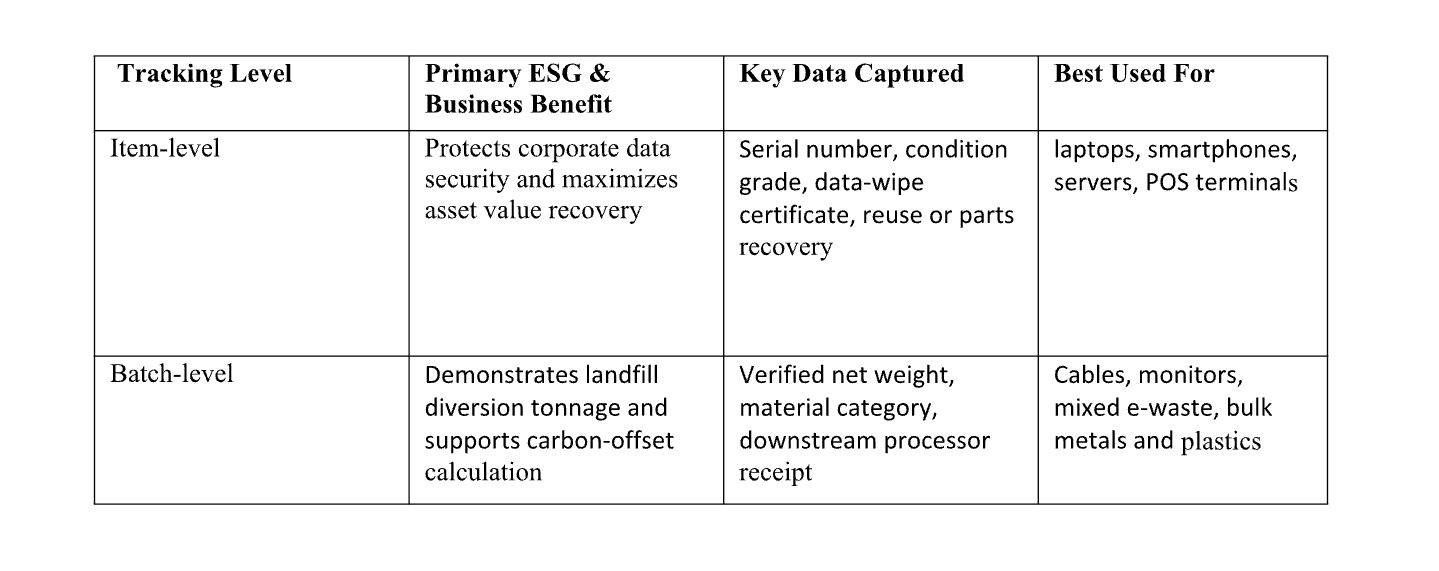
Different corporate waste streams carry different financial, security, and environmental profiles. Combining granular item-level tracking with scalable batch-level tracking gives sustainability and IT teams complete visibility without slowing down operations.
-
Item-level tracking applies to high-value, data-bearing assets such as laptops, smartphones, servers, and point-of-sale (POS) terminals. Recording each unit by serial number, condition grade, and data-wiping certificate protects corporate information security while capturing maximum refurbishment and reuse value.
-
Batch-level tracking applies to bulk materials such as cables, monitors, mixed e-waste, metals, and plastics. Logging net weights by material category and attaching downstream recycling receipts enables accurate landfill-diversion accounting and emissions modeling.
Turning Verified Waste Data into Audit-Ready ESG Reporting
Structured waste records turn routine IT refresh cycles and facility clearances into defensible inputs for Environmental, Social, and Governance (ESG) disclosures.
Audit-Ready ESG and Recycling Certificates
A centralized traceability ledger compiles collection dates, net weights, material breakdowns, transit logs, and downstream recovery certificates in one place. Sustainability teams can generate standardized, audit-ready recycling certificates on demand and spot documentation gaps well before external assurance reviews.
Quantifying Carbon Avoidance and Scope 3 Impact
Granular recovery data also strengthens Scope 3 emissions accounting. Extending the lifespan of laptops and servers through verified refurbishment avoids emissions tied to manufacturing new hardware, while recovering metals and plastics reduces reliance on virgin extraction. With verified weight and reuse metrics, companies can apply recognized emissions factors rather than rough estimates.
Supporting Mauritius’s Circular Economy Transition
Across Mauritius, corporate leaders face growing expectations to align resource management with national sustainability and circular economy priorities. Because island operations rely heavily on imported electronics and disciplined downstream export or local recovery channels, verifiable digital records give Mauritian businesses clear proof of compliant handling across every collection cycle. Read more on Mauritius’s circular economy priorities.
How BuyScrap Mauritius Brings Full Traceability to Island Businesses
Organizations in Mauritius need more than routine waste haulage, they need verifiable proof of where retired electronics go, how data is protected, and what materials are recovered. BuyScrap Mauritius, powered by EcoDash Technologies, pairs compliant physical collection with end-to-end digital chain-of-custody tracking built for island enterprises.
From Collection to Verified Recovery
EcoDash connects scheduled business pickups with vetted downstream processors and live digital tracking. Sustainability, IT, and procurement teams can monitor waste movements from initial onboarding through weighing, refurbishment, and final recovery—receiving organized documentation ready for internal governance and annual ESG reporting.
Built for Enterprise Accountability
For banks, telecommunications operators, hospitality groups, and corporate offices across Mauritius, EcoDash turns e-waste management into a measurable, transparent workflow guided by one principle: “Recycle smart. Track everything.”
Planning an upcoming IT equipment upgrade or preparing your next ESG report? Book a traceability consultation or register for corporate onboarding with EcoDash Technologies Mauritius.
Frequently Asked Questions (FAQ)
1. What is chain-of-custody tracking in waste management?
Chain-of-custody tracking documents a waste item’s complete journey from initial pickup through transport, sorting, refurbishment, and final material recovery. Recording weights, timestamps, and handler sign-offs at every stage allows organizations to prove how their waste was managed.
2. How does digital traceability prevent greenwashing?
Digital traceability replaces unverified sustainability claims with time-stamped records, calibrated weight logs, and downstream processor certificates. By tying every environmental statement to verifiable data, businesses can substantiate recycling and landfill-diversion figures with confidence.
3. Why is digital waste tracking important for corporate ESG reporting in Mauritius?
Digital waste tracking gives businesses in Mauritius reliable diversion metrics, certified data-destruction records for retired IT assets, and downstream recovery proof. This strengthens audit readiness, supports Scope 3 reporting, and demonstrates accountable resource stewardship.

